A Van, Word of Mouth, and #20 on Google: How One Barnet Gardener Became Impossible to Miss
Meet a gardener in Barnet, North London. He has been doing this since 2008. Clean work, fair prices, the kind of customer list that only comes from years of turning up and doing the job properly. If you knew him, you loved him.
That was the problem. You had to already know him.
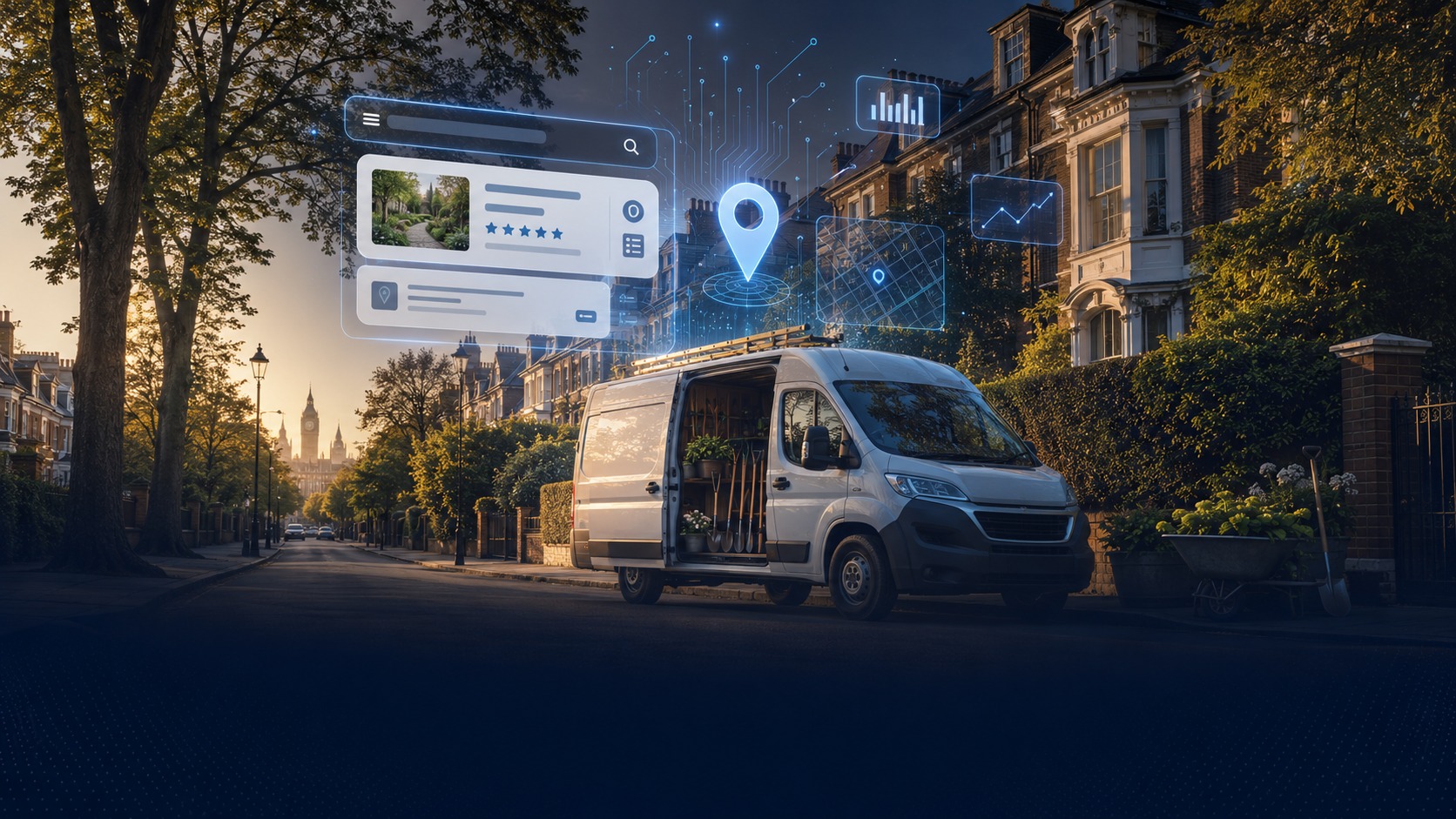
His only real advertisement was the van. It parked outside the job, someone walking past clocked the phone number, and once in a while that turned into a call. Everything else was word of mouth. When the regulars went quiet, so did the phone. A business with a genuinely great reputation was completely at the mercy of who happened to mention his name that week.
He did have a website. Technically. It sat somewhere around the bottom of page two on Google, invisible beyond position 20 in parts of his own town, and even if you found it, it did not make you want to pick up the phone. It was not selling for him. It was just there.
This is the story of what changed. Not with a bigger ad budget, he has spent nothing on ads, but with a website built for how people actually find local businesses now: through Google, and increasingly through AI.
Twentieth place on Google is the same as invisible
Let us be blunt about what “ranked #20” means for a local business.
Nobody scrolls to position 20. People searching “gardener in Barnet” or “landscaper near me” look at the map pack, the first three or four results, maybe the rest of page one on a good day, and then they call someone. If you are on page two, you do not exist. You are paying for a website that no new customer will ever see.
And this is a searcher with money in hand. Somebody typing “landscaper Barnet” is not browsing for fun. They have a job they want doing and they are about to hire whoever they find first. Every one of those searches that did not surface his business was a customer handed straight to a competitor, for no reason other than visibility.
He had the reviews. He had the 5.0 star rating. He just was not in the room when the decision got made.
The bigger shift: your customers are asking AI now
Here is the change almost nobody has adjusted to yet. For twenty years, “getting found” meant one thing: rank on Google. That still matters, and we will get to his Google numbers. But a second front has opened up, fast, and it is enormous.
A huge and growing share of people no longer start at a search box. They ask an assistant. They open ChatGPT, or Google’s Gemini, or Claude, and they type “who is a good gardener in Barnet?” And the AI answers with a shortlist of actual businesses.
This is not a niche. Look at the size of the audience that now behaves this way.
ChatGPT alone hit around 800 million weekly users in late 2025 and has kept climbing. Gemini is in the hundreds of millions monthly. And because Google now puts an AI answer at the top of ordinary searches, its AI Overviews reach over two billion people a month. AI-powered search went from roughly 5-6% of the market at the start of 2025 to an estimated 12-15% by the end of it, and AI answers now appear on around half of all Google searches. This is not coming. It is here, and it is where your next customer is looking.
Being recommended by the AI is the new page one
So we did the obvious test. We asked the big assistants, in July 2026, for the best gardeners in Barnet. Here is where our client landed.
Gemini put him first. Claude put him seventh. ChatGPT put him tenth, in a town packed with gardening firms, so cracking any top-ten list is a real result. Grok did not rank him, which is a useful reminder that this is a moving target and no single result is guaranteed. But three of the four assistants most people actually use now hand his name to a customer who asked.
Think about what that means. The customer never saw a list of thirty firms and skipped him. The AI gave them three or four names, and his was one of them. That is the new page one, and he is on it.
Why does Gemini, of all of them, put him first? Almost certainly because his new website is built the way Google’s AI wants to read it: clean, structured, and machine-readable, which we will come to. The assistants can only recommend what they can confidently understand, and most local websites give them very little to work with.
Most local businesses are invisible to AI, and don’t know it
This is the part that should make every local business owner sit up.
By one analysis, 98.8% of local businesses simply do not appear in AI-generated results at all. They are not being beaten. They are not in the contest. When someone asks an assistant for a plumber, an electrician, a gardener in their town, those businesses are invisible, because their websites were never built for a machine to read.
And most were not. The typical small-business site is old HTML, slow, thin on content, no blog, no project write-ups, no structured data telling a machine what the business does, where it works, and how to book it. A human can just about squint through it. An AI reaches for whoever it can read cleanly instead, and hands them the recommendation. Pages that expose proper structured data are several times more likely to show up in AI answers than pages without it. The gap is not talent or price. It is whether the website speaks the machine’s language.
That is the whole opportunity. Get this right now, while almost everyone else is in the 98.8%, and you are the name the AI reaches for.
So we built him a website people AND machines can read
Step one was a proper website. Fast, modern, clean, the kind of site that actually makes you want to call.
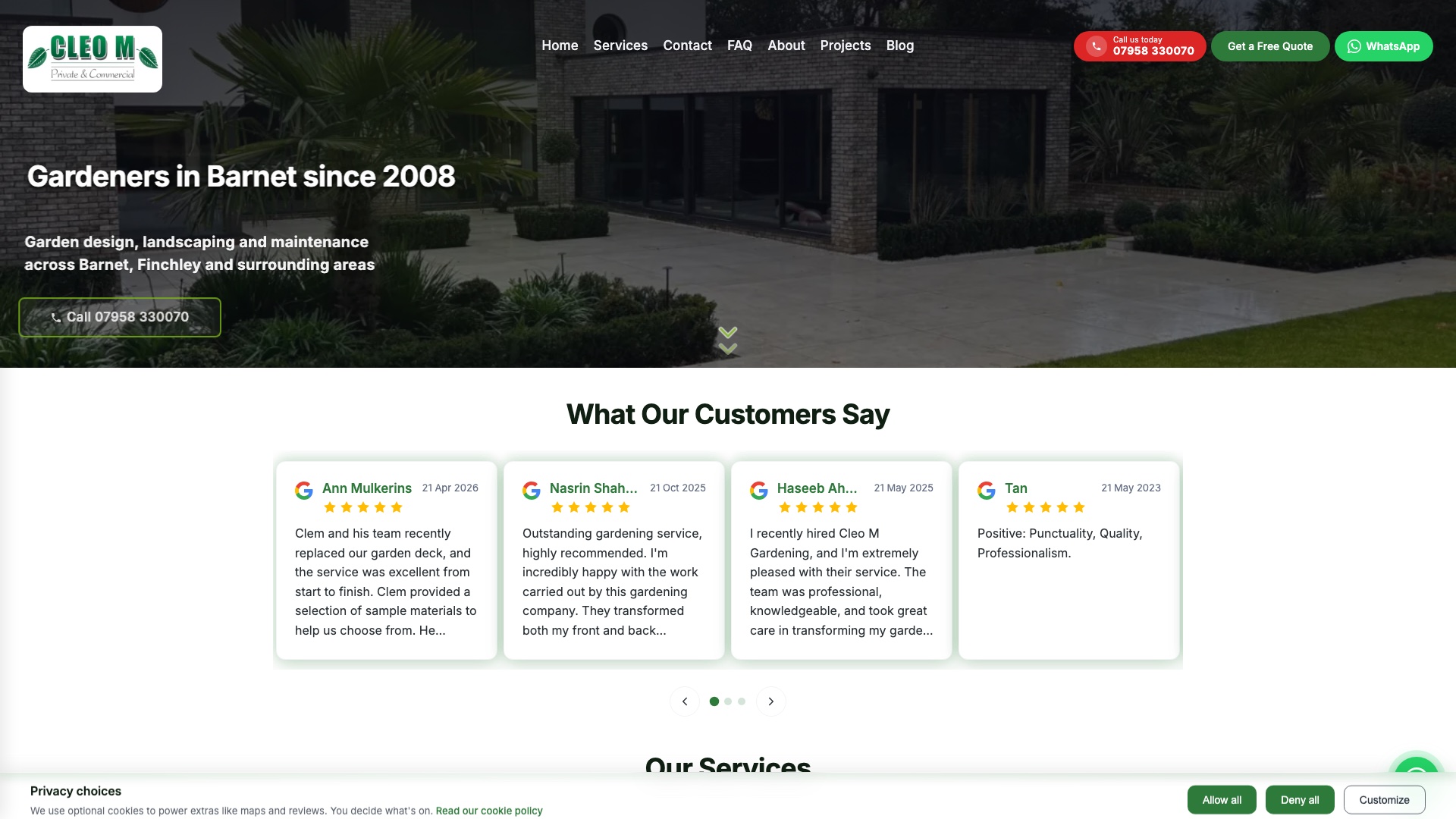
But looking good for humans was only half the job. The other half is invisible to the visitor and decisive for AI. Every page on the site has a clean, machine-readable twin: ask for the page as an AI agent would and you get tidy structured text instead of tangled HTML. There is an index that points assistants at the whole site, and a set of tools an AI agent can actually call, so a bot can look up a service or start a quote without scraping and guessing.
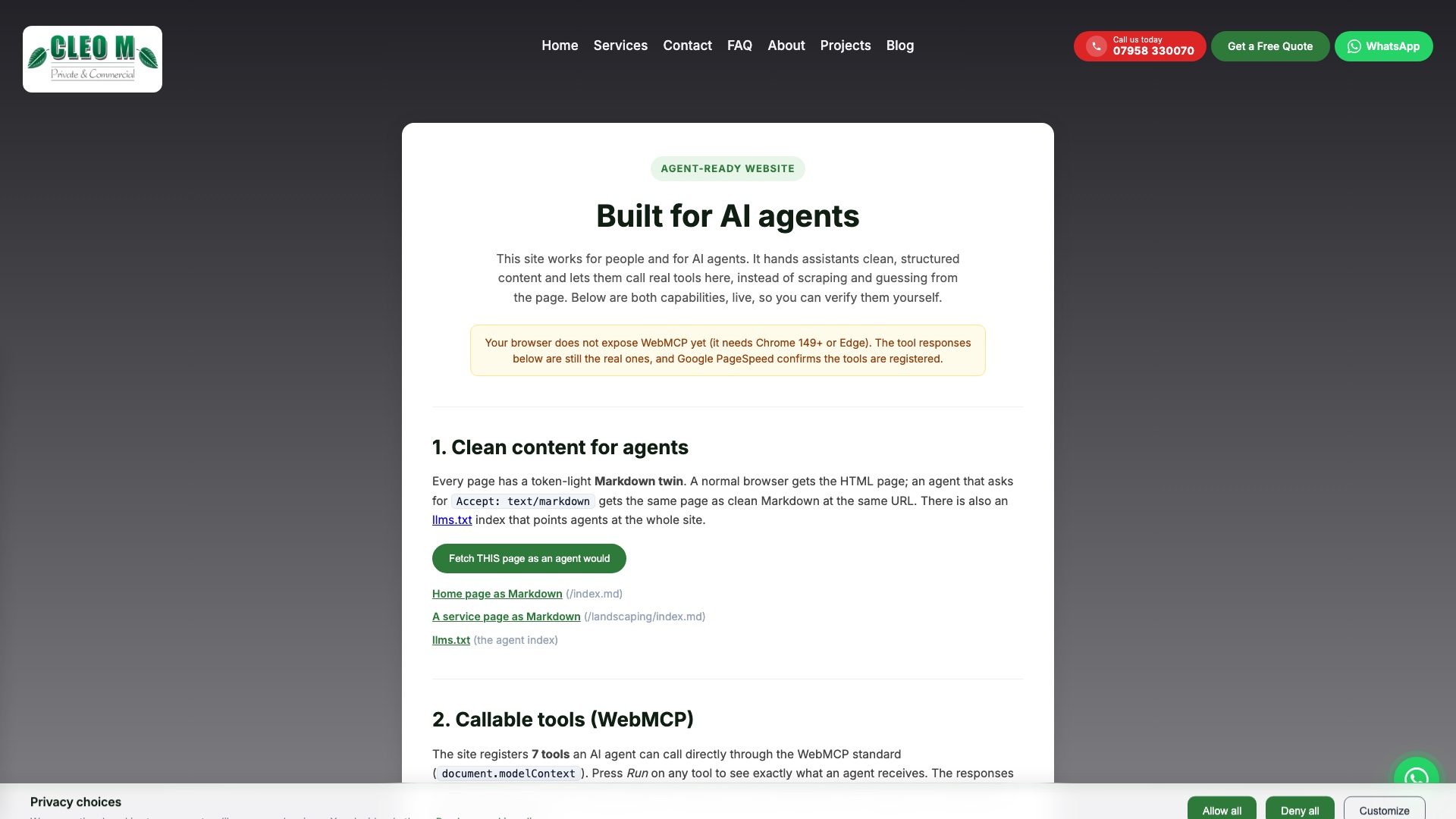
In plain terms: when ChatGPT, Gemini, Claude, or a WhatsApp assistant comes looking, it finds the answer instantly and in a form it trusts. That is the difference between being recommended and being skipped.
Ready for the next step: booking a quote straight from AI
Here is where it gets genuinely interesting, and why we build every site this way even before a client asks.
Right now the AI recommends a business. Very soon, it will act for the customer. You will tell Gemini or ChatGPT “find me a gardener in Barnet and get me a quote for clearing the back garden,” and the assistant will read the business’s site, find the services and the request-a-quote form, and submit it for you. No clicking through five pages. The customer asks, the AI does the legwork, and a fresh lead lands in the owner’s inbox.
The businesses that win in that world are the ones whose sites an AI can already read and act on. That is not a someday bet, Google and the AI labs are shipping pieces of it now, so we build every site ready for it today. When it flips on for everyone, our clients are already on the right side of it.
It is not a website. It is a lead machine.
A website on its own is a shop on a quiet street. What turns it into an engine is what you plug into it, and this is the part owners feel the fastest.
The site has its own cookie-consent manager, so it is privacy-compliant from day one. It has its own visitor analytics, so we can see what is working. And its form is wired to a proper backend and a leads dashboard the owner actually owns. When someone fills in the form, the lead lands in his own dashboard, and he gets a notification on his phone and an email. No lead lost in a spam folder.
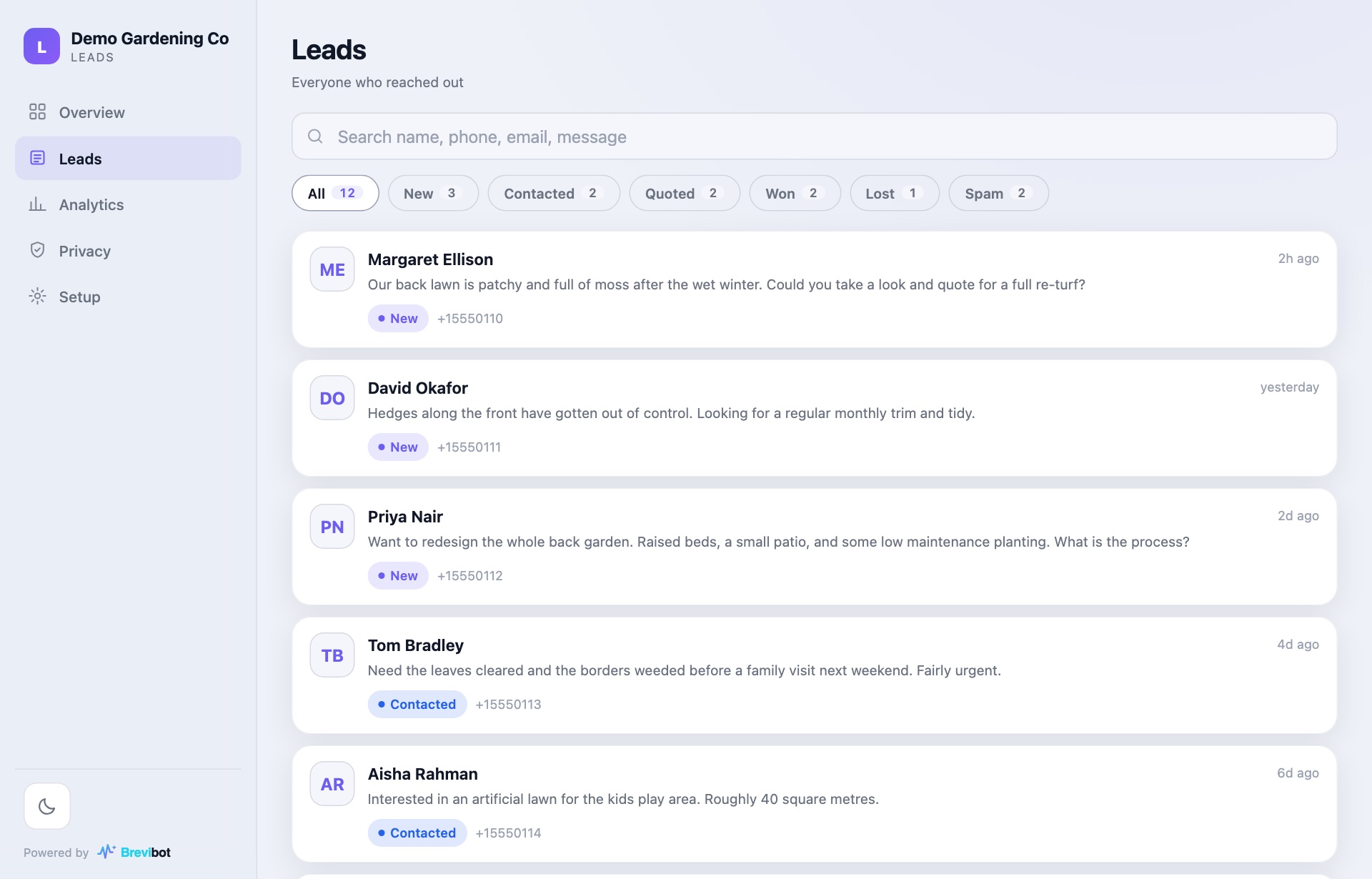
Open a lead and the owner can call, WhatsApp, or email in one tap, read exactly what the customer asked for, set the status, and keep private notes on the job.
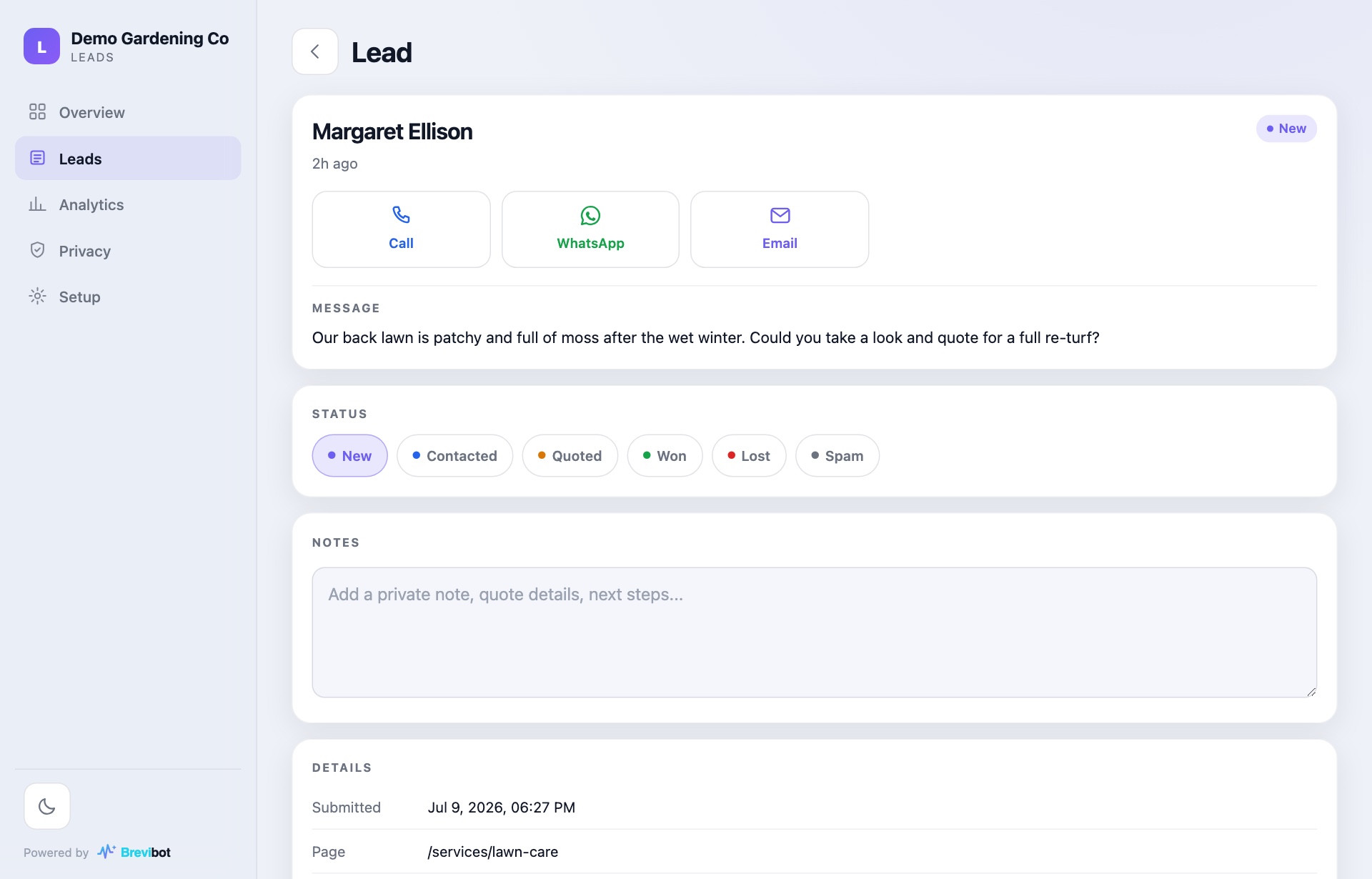
And it works. Within moments of the new site going live with that form, someone in his area filled it in. A real potential customer, from exactly the kind of search that used to hand his competitors the job. The form had barely been live and it was already doing the thing his old site never did in years.
What happened on Google after we hit publish
The AI results are the new story. The Google results are the proof it is all connected. We had been tracking his local ranking for months across 25 points around Barnet, so we had a clean before-and-after. Here is what moved:
- Average local rank went from 12.5 to 7.5, an improvement of about 40%. Bottom-of-page-two to genuinely competitive.
- His visibility more than doubled. Share of voice, the slice of local searches where he shows up, rose around 2.4 times.
- At his own doorstep he is now #1 for “landscaper.”
- He is now #4 in the whole local field, on a 5.0 star rating, closing on firms established far longer.
- The single biggest jump in the entire tracking history landed on the first scan after the new website went live. Exactly where a well-built site should start paying off.
Same gardener. Same great work. The website is what put him in the room.
Then you make it compound: social and ads
A website is step one, not the whole plan. Alongside it we set up the pieces that feed it. His Google Business Profile, which was in a rough state, cleaned up and working. His Facebook and Instagram, set up properly, because social is one of the best low-cost lead sources a local trade has and he simply was not using it.
Now we are posting: photos of real jobs, short videos, the before-and-afters that gardening is perfect for. Every post does two things: it puts his work in front of local people, and it feeds the whole system the fresh, genuine content that Google and the AIs reward. A quiet month no longer means a silent phone.
And it goes further. Once we see which posts land, we put a small, targeted budget behind the winners in his exact area. You are not guessing at an ad, you are amplifying something you already know works, aimed at the postcodes where the customers are. That is how a good reputation becomes a predictable stream of enquiries.
The bottom line
A skilled tradesman with a great reputation was nearly invisible to everyone who did not already know him. His whole marketing strategy was a van and other people’s good word.
Now, without a penny on ads, he is #4 on Google in his area, #1 at his own doorstep, the gardener Gemini recommends first and ChatGPT and Claude both list, getting leads straight from his website, and building a social presence that feeds the whole thing. The only thing that changed is that when a customer goes looking, on Google or by asking an AI, they actually find him.
That is the whole game. The work was always good enough. It just needed to be findable, by people and by the machines those people increasingly ask. And right now, while 98.8% of local businesses are invisible to those machines, there is a real head start on the table for the ones who move first.
🌱 Want a website like this for your business?
This is exactly what we build at Brevibot: fast, modern websites that people love and AI can read, wired into Google, social, and a leads dashboard you own. If you would like us to build one for you, tell us about your business at brevibot.com, or message us on WhatsApp, and we will take it from there.
Get a website like this at Brevibot.com